How to Win the New Investor Class
Executive Summary
The next generation of investors, under 35, financially cautious, and culturally fluent, isn’t learning from banks. They’re learning from TikTok explainers, creator-finance threads, and relatable reels that meet them where they scroll.
This report unpacks how next-gen investors navigate financial content online: who they trust, where they learn, and why they convert. We explore the rise of creator-coaches, platforms that teach as they build, and the sticky UX experiences that outperform splashy campaigns.
Whether you're a fintech startup, legacy bank, or investment platform, this is essential reading for marketing teams, product designers, and brand leaders ready to meet under-35s where they are and grow with them.
Key takeaways
- They want a relatable coach, not a banker. Finance fluency is aspirational but it needs to feel human and achievable
- Trust starts with tone. Teaching beats preaching. Brands win when they guide like a peer, not a platform.
- Creators are the new curriculum. Trusted voices like Your Rich BFF, Her First 100K, and BreakYourBudget win because they blend truth, transparency, and humor.
- Finance is identity content. Investing advice lives next to skincare routines, meal prep, and breakup survival kits.
- Sticky UX > flashy features. Platforms that make users feel smart (not overwhelmed) earn loyalty, not just clicks.
We unpacked how the next generation of investors is reshaping the financial landscape—and how financial brands can meet them where they are.
Research Questions
- Who are today’s first-time investors, and what makes them different from past generations?
- Where are they learning about money and who do they trust?
- What kinds of content, formats, and voices actually drive action?
- What product and UX elements make them stick around?
- How can financial brands show up with relevance and cultural fluency across regions and demographics?
Our Approach
- We analyzed under-35s content behavior across major platforms, using digital signal data to surface their financial mindsets, emotional drivers, and scroll habits.
- We decoded how creators earn trust: from the story arcs that teach without preaching to the formats that balance relatability with real guidance.
- We studied high-performing trends like “Extreme Spending Stories” and “Wealth Psychology & Habits,” revealing the emotional mechanics behind shares, saves, and conversions.
- We examined the UX features that matter most to under-35s, from bite-sized coaching and warm tone to Chime-style progress nudges that make money feel less intimidating.
- We mapped opportunity zones like Atlanta, Houston, and TikTok’s Black/Latinx finance communities, to spotlight untapped reach potential.
Today’s first-time investors in the U.S., largely Gen Z and young Millennials, are entering the financial world with curiosity, skepticism, and a lifestyle-first lens. They want content that fits their feed, tools that match their pace, and brands that understand their financial anxieties without condescending to them.
This report unpacks the platforms they trust, the creators they follow, and the cultural context shaping how they save, spend, and invest.
Welcome to the new investor class: self-starting, emotionally savvy, and financially curious.
Rightmetric is an outsight partner that brings clarity to the external landscape so you can lead with confidence.

The Age of Insecurity
For Gen Z and young Millennials, financial “adulthood” doesn’t come with a corner office or a starter home. It comes with student debt, paycheck-to-paycheck living, and TikToks about side hustles that barely cover rent.
According to Deloitte’s global 2025 Gen Z and Millennial Survey 1 , nearly half of Gen Z (48%) report feeling financially insecure, and over 50% live paycheck to paycheck.
This generation absorbs money worries into their self-worth. “ Only 28% of financially insecure Gen Zs say they felt happy in the past year. 1 ”
1 Deloitte Global Gen Z and millennial survey 2025. Deloitte. (n.d.). https://www.deloitte.com/global/en/issues/work/genz-millennial-survey.html
Demographic Depth

The under-35s finance audience in the US1 has more females than males, indicating that young women have a growing interestin financial topics and are actively taking charge of their finances.
The financial audience within the under-35s demographic reflect both diversity and disparity. There is slightly higher representation of White (65%) and Asian (9%) first-time investors compared to national baselines, while Black and Hispanic audiences are slightly underrepresented, both sitting at 12% versus baseline 13% and 19%, respectively.1 This adds cultural precision to how we talk about under-35s, deepens our understanding of inclusion gaps, and sets up more targeted strategies in later chapters.
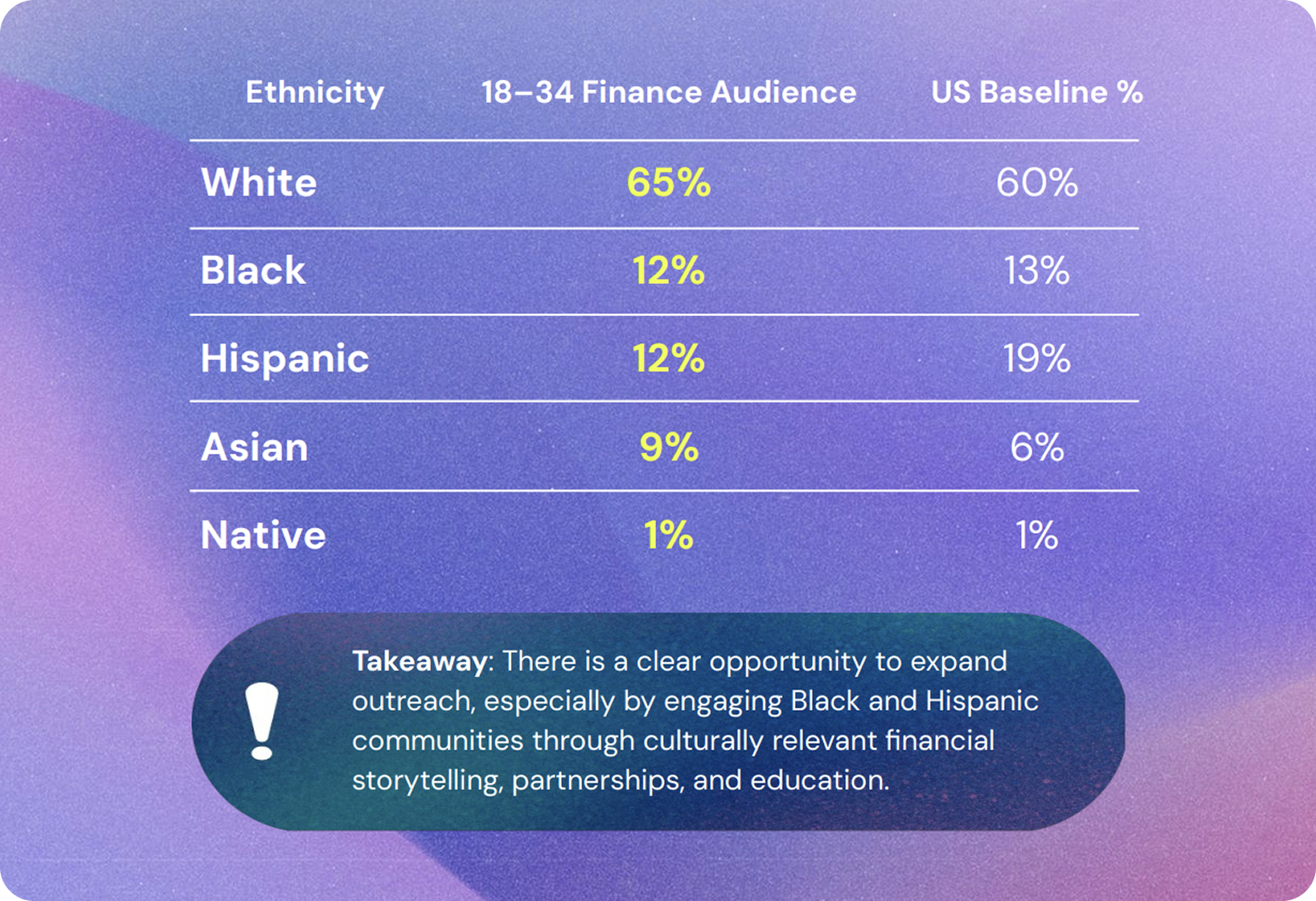
1 Audience insights are based on social affinity data modeled from large-scale digital behavior patterns from a 130,000+ sample size. Values are directional, not absolute, and best used to understand relative interest and clustering trends.
The states that over-index for under-35s investors, California, Texas, Florida, Colorado, and Massachusetts, highlight how access and environment drive financial engagement. These regions offer fertile ground for brand activations, creator collaborations, and targeted media campaigns.
- Texas exemplifies how investment follows infrastructure. Home to ~40% of the nation’s crypto investment, the state boasts $4 billion committed and 12,000 jobs clustered around hubs like Austin and North Texas, reinforcing its role as a digital finance leader.2
- California’s fintech ecosystem, powered by Silicon Valley, continues to attract tech-native next-gen investors. Meanwhile, New York—despite being a global financial capital—underperforms with under-35s first-time investors (6% of audience vs. 8% national baseline), possibly due to high living costs or perceived entry barriers. However, as tech talent migrates east from California, New York may be on the cusp of an under-35s fintech revival—one that brands should watch closely.
- Atlanta is already setting the pace. With under-35s representation doubling the national average (4% vs. 2%), it’s a prime market for culturally resonant storytelling, particularly around Black under-35s wealth-building. For brands, Atlanta offers a blueprint for inclusive, community-driven financial engagement.
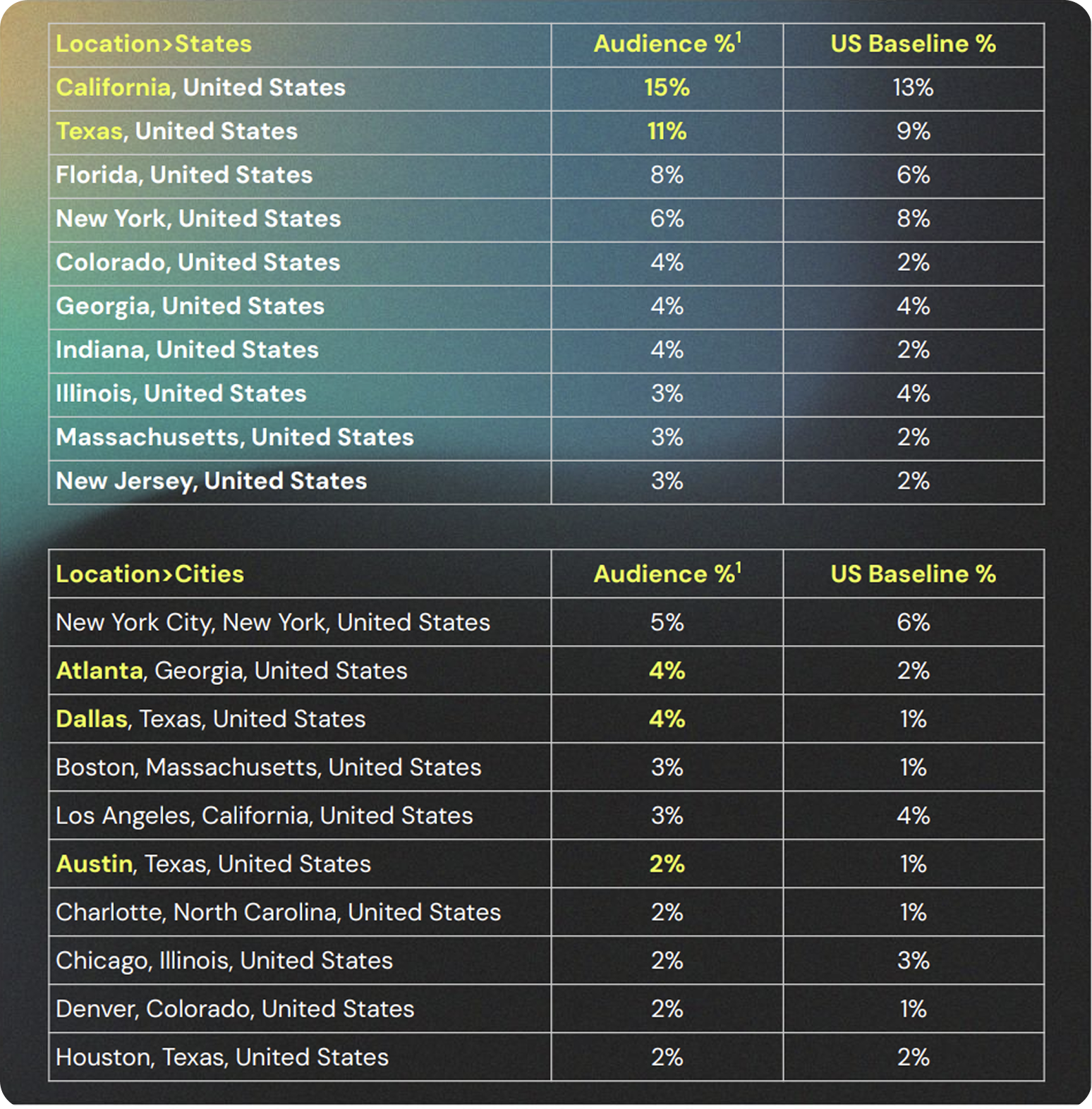
1 Audience insights are based on social affinity data modeled from large-scale digital behavior patterns from a 130,000+ sample size. Values are directional, not absolute, and best used to understand relative interest and clustering trends. 2 Guo, K. (2025, February 21). Watch crypto leaders on the future of Bitcoin Mining and Energy Innovation in Texas. The Texas Tribune. https://www.texastribune.org/2025/02/20/texas-technology-blockchain/
Under-35s are ready to invest, but the financial world still speaks a different language.
Under-35s are showing up with hustle. Very few come from the most elite schools (Tier 1), and over half attended lower-ranked institutions (Tier 4)1 . While they slightly over-index on mid-tier universities (Tiers 2 and 3), they’re still climbing uphill—earning just enough (~$40K/year) to enter the market, but not enough to feel secure inside it.
They’re asking for guidance that speaks human: tools that feel personal and platforms that make them feel they belong even if they only just found the door.
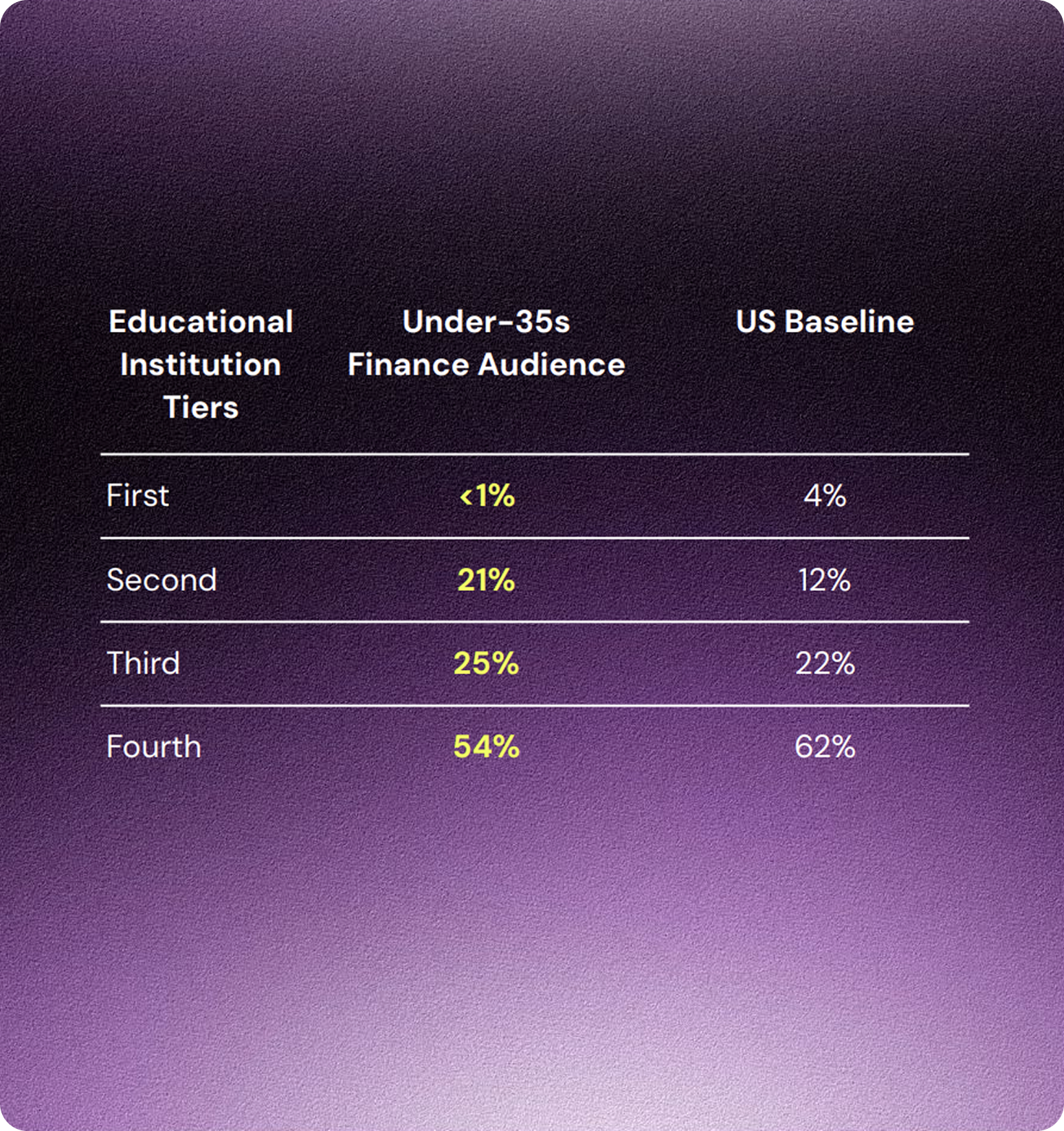
1 Educational Tiers classify audiences based on self-reported post-secondary institutions, ranked using national and global systems like U.S. News & World Report. The model draws from social and digital data to reflect the academic prestige and reputation of each school. Educational Tiers classify audiences by self-reported colleges and universities, ranked by academic prestige using national and global systems, from Tier 1 (top 4%, e.g., Harvard, MIT) to Tier 4 (26th–50th percentile, e.g., San Diego State, University of Tulsa). 2 Barber, R. (2024, November 26). From gen Z to boomers: How much money each generation thinks they need for success. USA Today. https://www.usatoday.com/story/money/2024/11/26/what-each-generation-earns-gen-z-boomers/76588503007/
This generation wants a guide in their corner.
They're skeptical of institutions but hungry to learn, shaped more by peers and TikTok threads than by textbooks. Winning their trust means showing up with empathy, cultural fluency, and tools that match their mindset and their wallet. The chapters ahead unpack what it takes to engage them:
- The content formats that earn attention
- The creators they trust most and why
- How they emotionally relate to finance
- What they expect from products and platforms
When finance feels intuitive, human, and scroll-native, under-35s pay attention and participate.

KEY TAKEAWAY #1
Trust is earned through relatability, not expertise

Sentiment and community response to financial content
Under-35s's engagement with financial content is profoundly shaped by authenticity and relatability, often favoring narratives that convey personal learning experiences over prescriptive advice. The sentiment analysis of top-performing content reveals a strong preference for creators who share "here's what I learned" rather than "here's what you should do". This indicates a fundamental shift towards peer-to-peer learning and transparent narratives, moving away from the authoritative, often distant, tone of traditional financial institutions.
Content that leans into humor and shock, like stories of financial missteps or absurd spending choices, consistently pulls strong engagement. Audiences often react with high-frequency slang like “bro,” “suck,” or “trick,” signaling a mix of entertainment, disbelief, and relatability. Even serious topics become approachable when wrapped in unexpected or sarcastic storytelling. Similarly, personal financial journeys that showcase “extreme” decisions (e.g. draining a 401k to buy a gaming PC) invite reflection and lively comment threads. Viewers compare their own values, share “what I would’ve done” takes, and turn the comment section into a space for peer-led financial dialogue.
What makes under-35s engage with financial content
The best-performing finance content for this audience blends education, emotion, and entertainment—activating multiple learning styles at once.
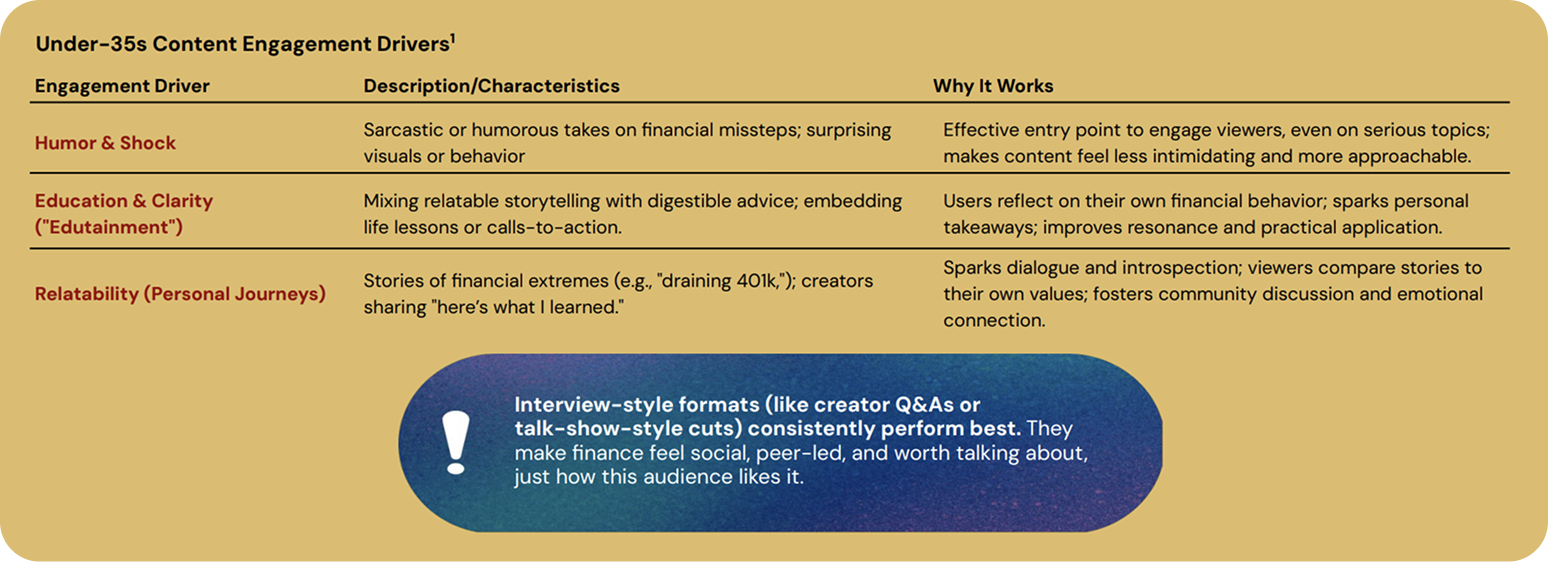
1 We analyzed over 500 social video posts from top investing platforms and finfluencers across social channels. Each video was categorized into a core content theme. We then ranked those themes by average views and engagements (V+E) to surface what truly resonates, not just what gets published. Analysis reflects data as of May 2025. Raw video view data for YouTube, Facebook, and TikTok is sourced from Tubular Labs. Instagram video views and analysis are based on proprietary analysis using third-party ad intelligence tools
Top performing content by engagement
We analyzed which types of content consistently drive views and shares among under-35s. The top performers tap into two key dynamics: emotional contrast and psychological depth — helping younger audiences decode not just what to do with money, but why.
- Millionaire Challenge (4.8M) reveals how millionaires achieved their success, while also posing fun challenges and questions for them to answer.
- Wealth Psychology & Tips (4M) content taps into relatable aspiration: how “regular” people can build wealth from the ground up.
- Extreme Spending Stories (3.7M) highlights under-35s’s fascination with the extremes of financial behavior — lavish or frugal.
- Cost of Living (3.5M) covers hot topics like renting vs. owning a home, the effects of tariffs, and the struggles of managing personal finances.
- Famous Wealth (3.4M) takes a closer look at how celebrities grow and spend their fortunes, all with an entertaining twist.
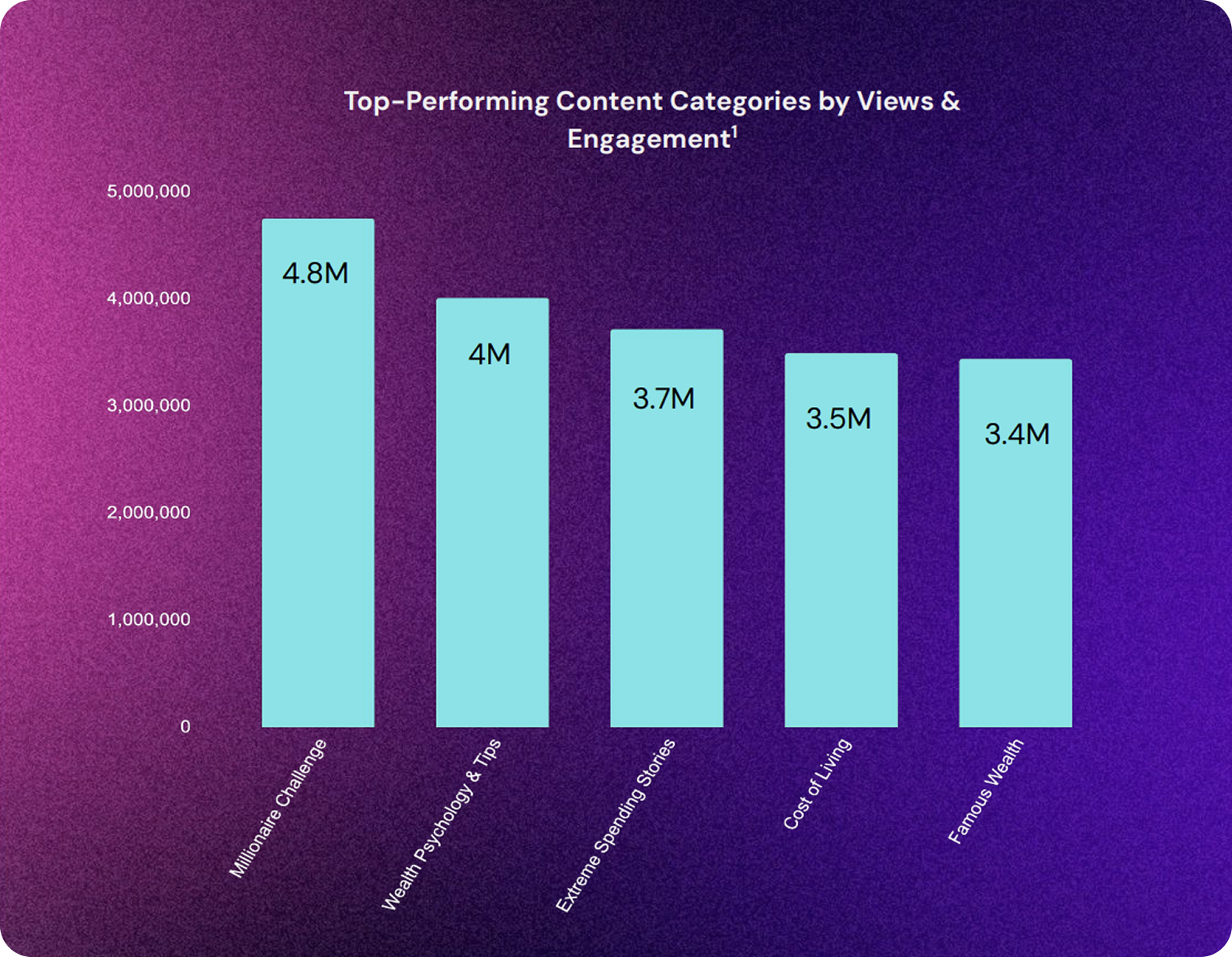
1 To triangulate top-performing content by engagement, we analyzed over 500 social video posts from top investing platforms and finfluencers across social channels. Each video was categorized into a core content theme. We then ranked those themes by average views and engagements (V+E) to surface what truly resonates, not just what gets published. Analysis reflects data as of May 2025. Raw video view data for YouTube, Facebook, and TikTok is sourced from Tubular Labs. Instagram video views and analysis are based on proprietary analysis using third-party ad intelligence tools.
Content Breakdown
Millionaire Challenge Content is the most-engaged content theme with over 4 million views and engagement.
How Quickly Can You Spend $100 Billion? | Millionaire Challenge
Platform & Views: Instagram, 4.2M views
Length: 49 seconds (short-form)
Position: Humor: “Make this suck less.”
Tone: Humor & Shock Drive Engagement
This video vividly illustrates the immense scale of $100 billion through a gamified, humorous spending spree. CEO & YouTuber Mark Tilbury rapidly "purchases" items, from Big Macs to NBA teams, with each transaction visibly deducting from the starting sum. This real-time visual reduction makes the abstract figure tangible and comprehensible. The mix of mundane ("100 years of Netflix") and extravagant ("1000 Apache helicopters") purchases adds relatable absurdity, boosting engagement. The video concludes by showing the remaining sum is still dwarfed by figures like Elon Musk's net worth, emphasizing "The money's out there, go get yours!" and implicitly inspiring viewers toward their own financial goals by highlighting wealth's vastness.
Content Breakdown
Wealth Psychology & Habits rounds up the top 3 content themes with the highest engagement.
How To Be THE FIRST MILLIONAIRE in your family! | Wealth Psychology & Habits
Platform & Views: Instagram, 2.7M views
Length: 17 seconds (short-form)
Position: Education & Clarity: “Tell me what this means in my life.”
Tone: Education + Entertainment ("Edutainment") Works
This video reframes financial ambition through a powerful, personal lens: “Are you going to be the first millionaire in your family?” With warm music, bold captions, and direct-to-camera delivery, it builds urgency and intimacy. The core message flips scarcity into opportunity: “You don’t come from money but money can come from you.” Contextual visuals, cash, family moments, aspirational overlays, reinforce the narrative. The tone is confident yet relatable, making wealth-building feel less like a dream and more like a generational shift in motion. It’s a call to legacy, not luxury
Content Breakdown
Extreme Spending Stories came in third for next-gen engagement, so let’s break down what makes this content resonate so powerfully.
She Drained Her 401k To Buy a PC | Extreme Spending Stories
Platform & Views: TikTok, 3.8M views
Length: 30 seconds (short-form) Position:
Relatability: “Have you been through what I’m going through?”
Tone: Personal Financial Journeys Spark Dialogue
This financial audit-style video powerfully illustrates the long-term cost of short-sighted retirement decisions through a shocking personal anecdote. Influencer Caleb Hammer’s visceral reaction amplifies the mistake's severity for the audience. Initially, the guest claims "zero" retirement savings, but the host uncovers a $3,000 "Fidelity Disbursement," revealing an old 401K from age 18. Caleb’s incredulous emphasis on the "incredible" compound growth potential (18 to 59.5) highlights a significant missed opportunity. The dramatic reveal that she withdrew the entire amount to "buy a PC," turning a potential $25,000 into just $3,000, serves as a potent cautionary tale about preserving retirement investments. The segment's emotional intensity, fueled by the host's disbelief and the guest's casual admission, makes the financial lesson highly memorable and impactful.
Top Performing Branded Content
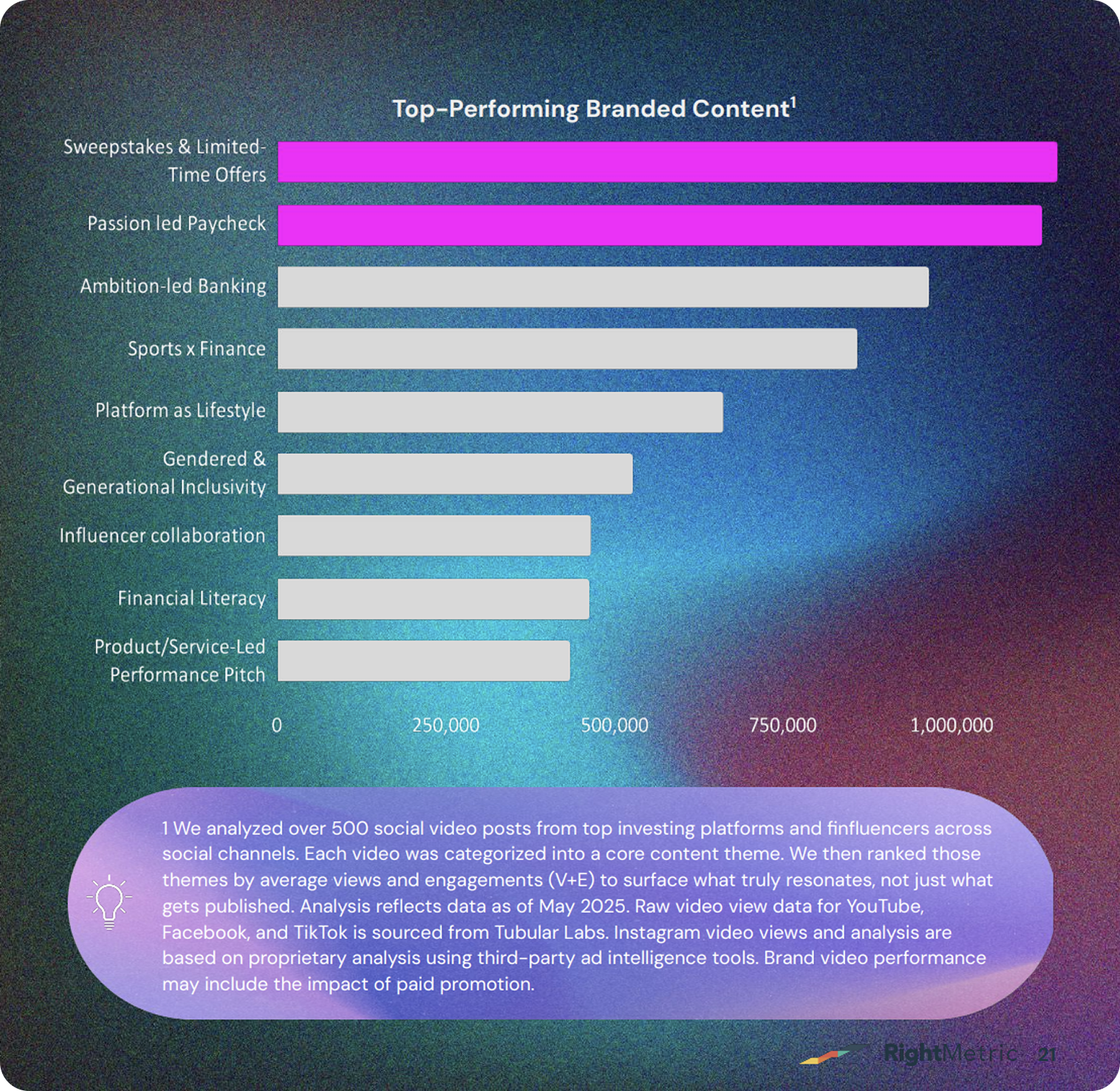
The best branded plays align with under-35s’ desire to redefine their money story and see brands as partners, not products.
- Narrative-led themes like Passion Paychecks, and Ambition Banking tap into identity and aspiration. They position your brand as a coach, not a calculator.
- Tactical drivers like Sweepstakes & Limited-Time Offers, and Product-Led Pitches spark visibility but themes like Platform-as-Lifestyle and Outlier Wins build long-term loyalty.
- Cultural fluency is non-negotiable. Content rooted in real experiences, Gendered & Generational Inclusivity, Creator Collabs, drive trust. Relatability outperforms authority.
The result is content that converts and compounds because it meets users where they are, and moves with them.
Content Breakdown
Sweepstakes & Limited-Time Offers (1.15M V&Es) lead in engagement, showing that urgency still converts especially when framed as exclusive or time-sensitive. Giveaways, countdowns, and “act now” campaigns are effective in grabbing immediate attention and encouraging action.
For a chance to win, sign up with promo code ‘MATCH’ and start investing. | Sweepstakes & LTOs
Platform & Views: Instagram, 8.4M views
Length: 13 seconds (short-form)
This direct-response advertisement for Acorns effectively leverages financial incentives to make abstract concepts tangible. It grabs attention by presenting a relatable statistic ("The average tax refund in the US this year was $3,177") and visually representing this amount with stacks of money. Acorns' offer to "match it to give you even more of a refund" taps directly into the viewer's desire for increased financial gain. The video provides a clear call to action —"Download the Acorns app and sign up with promo code MATCH"— reinforced by a visual walkthrough of the sign-up process for easy comprehension. A consistent legal disclaimer further enhances credibility and transparency
Content Breakdown
Passion-Led Paycheck (1.13M V&Es) content performs nearly as well, indicating under-35s’ strong interest in aligning income with identity. Stories that spotlight unconventional careers, creative hustles, or personal fulfillment over traditional paths strike a powerful chord.
@tonyhawk told @yourrichbff about how he had to scrimp when things slowed down in the skate industry | Passion-Led Paycheck
Platform & Views: TikTok, 12.7M views
Length: 31 seconds (short-form)
This video subtly promotes financial responsibility through an interview with Tony Hawk, highlighting the ephemeral nature of significant wealth. Leveraging a celebrity, it underscores the importance of financial management even for high earners. The video opens by surprisingly revealing Hawk made $160,000 before getting his driver's license, contrasting early success with youth. However, the narrative quickly shifts to his income dropping "very immediately in the early 90s," showing how many peers "lost their way" from "everything" to "nothing." This personal anecdote serves as a potent cautionary tale about financial instability. While not a direct product pitch, this SoFi-sponsored video implicitly advocates for careful financial planning and resilience, aligning with SoFi's mission. The interview format and relatable struggle enhance the message's impact and trustworthiness.
Content Breakdown
Ambition-Led Banking (965K V&Es) also sees strong traction, suggesting Gen Z is looking for brands that speak to their long-term growth financially and personally. These videos often pair product features with lifestyle aspiration and future-oriented goals.
Do you have a dream for your finances? Jayson Tatum had a vision for his, and basketball made it happen. | Ambition-Led Banking
Platform & Views: TikTok, 5.4M views
Length: 30 seconds (short-form)
This SoFi ad effectively uses a personal narrative to promote financial empowerment, leveraging an Jayson Tatum’s journey from humble beginnings to professional success, mirroring viewer aspirations. It opens with a relatable struggle: "Before the spotlight, we struggled to keep the lights on" , then transitions to the athlete's ambition to "make it to the league" and "get my money right", fostering an emotional connection. The narrative highlights how SoFi "gives members confidence to see more for themselves" and helps them "earn and save more money for their ambitions". The visual progression from a young boy playing basketball at night to a polished professional powerfully illustrates achieving financial goals. The video culminates with clear calls to action: "Believe you can get there with the next generation of banking" and "Join the Official Bank of the NBA", reinforcing SoFi's legitimacy and aligning it with aspirational success.
Implications for Tone-of-Voice and Messaging
The observed preference for authentic narratives and shared learning experiences highlights the power of vulnerability in financial storytelling. Under-35s value transparency and wants to see the human side of money, including mistakes and the process of learning from them. This implies that brands need to cultivate a more human, less corporate voice, embracing storytelling that includes personal challenges and lessons learned. This could involve featuring diverse real-life financial journeys or adopting a brand persona that is transparent and empathetic. The adoption of an interview-style content format, which makes financial topics conversational and socially validated, can be a highly effective tactical approach across various platforms. This approach allows for diverse perspectives and a less formal presentation of complex information, fostering a stronger connection with the audience. Ultimately, financial brands are granted permission to sound less like a traditional finance entity and more like a trusted individual whom their audience already respects and relates to.
KEY TAKEAWAY #2
The creators next-gen investors trust most don’t sell, they teach

Mapping content tone, sentiment and teaching formats
For under-35s, the most influential financial voices are not traditional authorities but rather relatable educators who prioritize teaching over selling. These creators build trust by adopting a tone that is friendly, authentic, and often humorous, making complex financial topics accessible and engaging. Their content often emphasizes personal learning journeys and transparent sharing of experiences, fostering a sense of camaraderie rather than a didactic relationship. This approach aligns with under-35's preference for peer-led, bite-sized, and emotionally resonant learning experiences, reflecting a broader shift towards creator-led ecosystems as a supplement or alternative to traditional education.
The effectiveness of this teaching-centric approach is evident in the sentiment and engagement patterns observed in top-performing financial content. Viewers respond strongly to "edutainment," where creators embed life lessons and calls-to-action within relatable storytelling. Humor and even shock value, often expressed through words like "bro" or "suck," serve as effective entry points to engage viewers on serious financial topics.
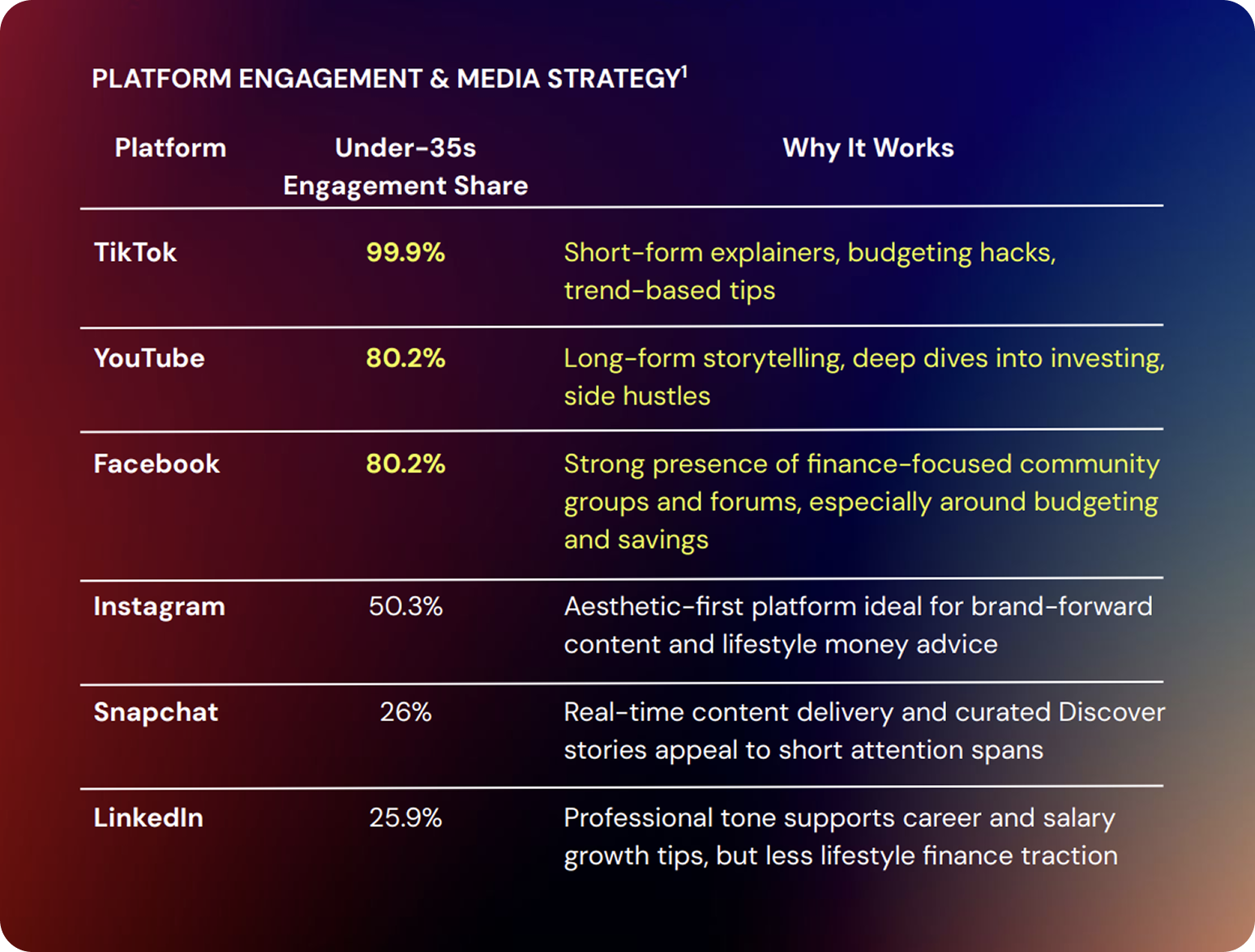
Under-35s' digital consumption patterns are diverse, yet specific platforms dominate their attention for financial content. TikTok stands out as the epicenter, with nearly 100% (99.9%) affinity1 (usage frequency and engagement) among this audience, serving as a primary channel for short-form explainers, budgeting hacks, and trend-based financial tips. YouTube also commands significant engagement (80.2% usage), supporting longer-form content such as deep dives into investing and financial education. Other platforms like Facebook (80.2%) host finance-focused community groups, while Instagram (50.3%) is utilized for aesthetic-first content and infographics.
Comparative Platform Engagement
1 Audience insights are based on social affinity data modeled from large-scale digital behavior patterns from a 130,000+ sample size. Values are directional, not absolute, and best used to understand relative interest and clustering trends. 2 Guo, K. (2025, February 21). Watch crypto leaders on the future of Bitcoin Mining and Energy Innovation in Texas. The Texas Tribune. https://www.texastribune.org/2025/02/20/texas-technology-bl ockchain/
Profiles of Top-Performing Financial Reports
For under-35s, the most trusted financial voices are relatable creators, They combine education, empathy, and entertainment to demystify money and make it feel human.

For financial brands, partnering with these types of creators is not simply a marketing tactic but a strategic imperative to deliver the financial curriculum under-35s are genuinely willing to learn from.
Collaboration should focus on explainer-style content, Q&A sessions, or collaborative series (e.g., "Ask Me Anything About Credit" on Instagram Stories). This approach leverages the creator's established authenticity and rapport with their audience, allowing brands to co-deliver content that builds trust and provides valuable education. By aligning with creators who prioritize teaching and relatability, financial brands can move beyond traditional marketing to become a trusted source of guidance for under-35s.
Strategic Approach to Influencer Partnerships
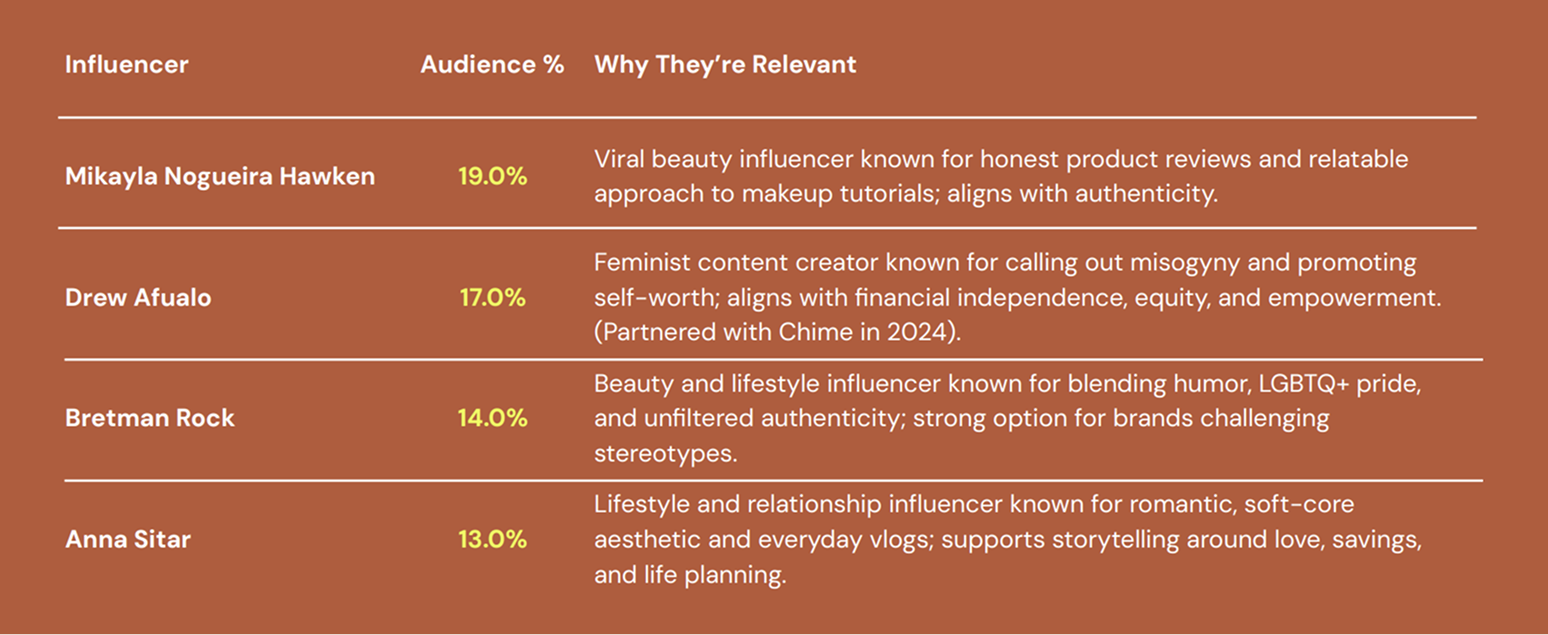
Fashion/Beauty Influencers
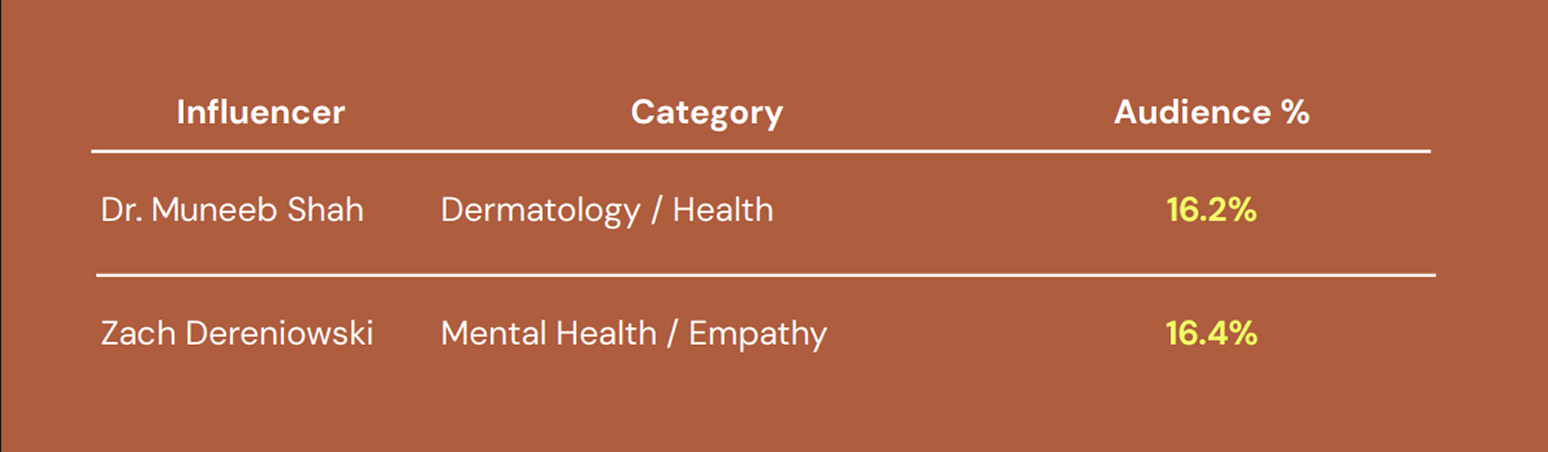
To make finance feel emotionally relevant, this audience also turns to adjacent creators who blend money with lifestyle.
Health/Wellness Influencers
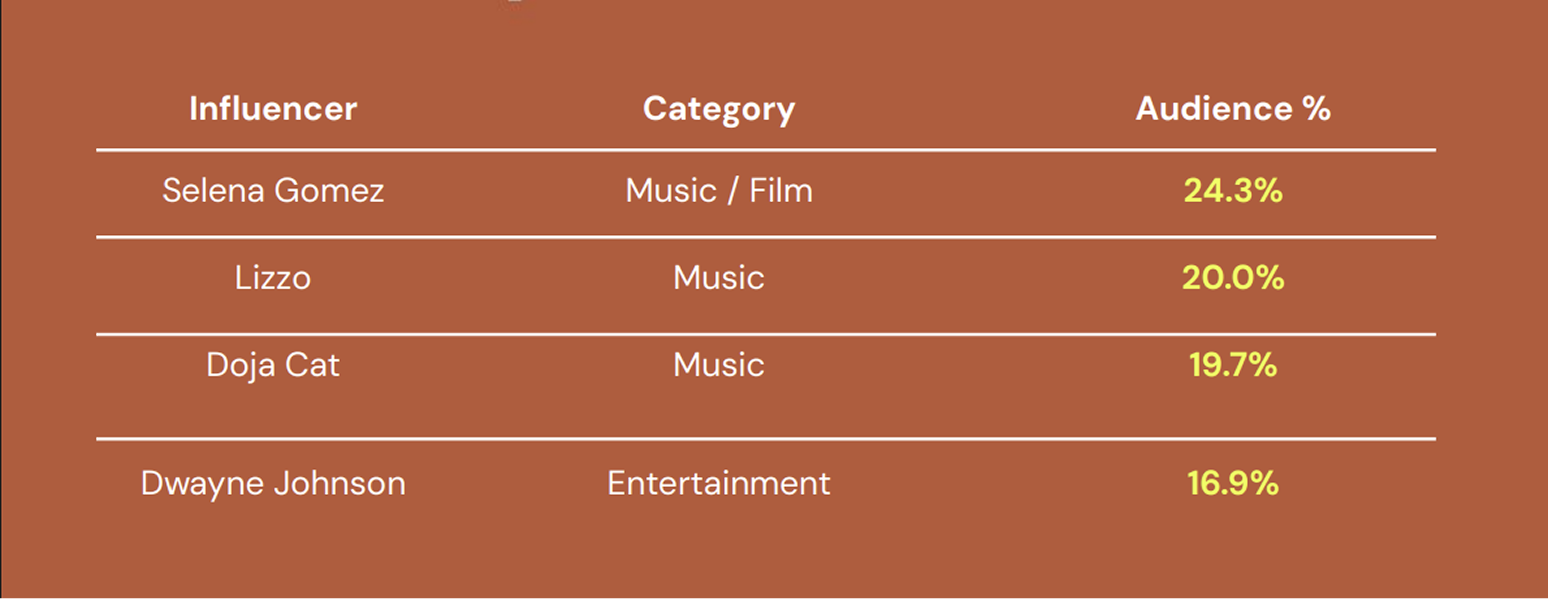
Music/Pop Culture Influencers
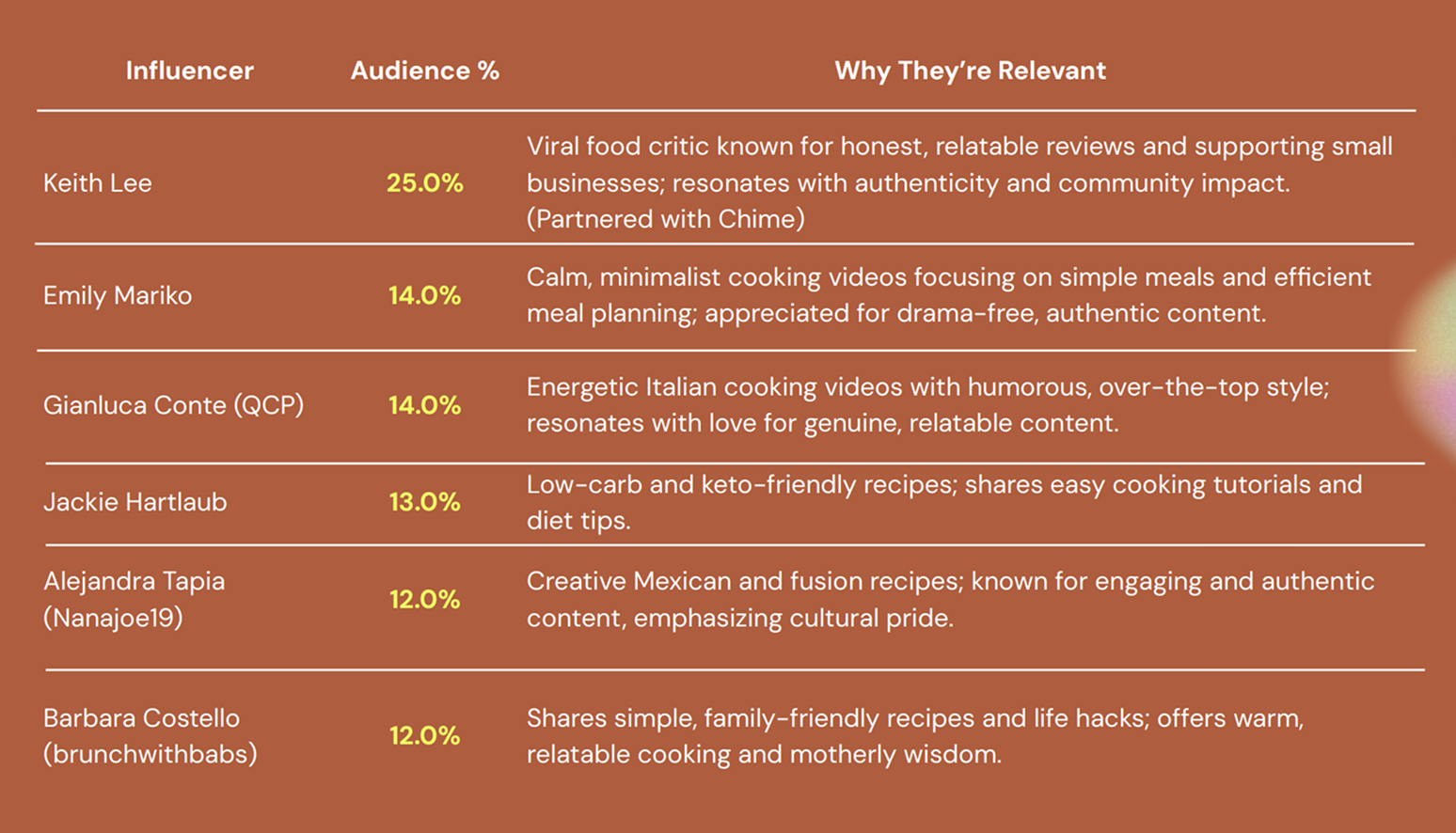
Food & Chef Creators
Entertainment & Comedy Creators

What we learn from who they trust
The next-gen investor learn from people. They follow creators who teach with empathy, entertain without condescension, and share real financial journeys. For financial brands, these creators are modern-day professors with loyal classrooms.
- Shift from ads to educators. Prioritize collabs with creators who explain money like a friend would, not a finance bro.
- Go beyond finance-first creators. Adjacent influencers (from beauty to food to mental health) can unlock emotional access points.
- Favor formats that feel social. Q&As, AMAs, and short-form stories outperform polished explainers.
- Tap into lifestyle + money overlap. Budgeting is as much about identity as it is about math. Mirror that in messaging.
- Build long-term partnerships. Ongoing creator collabs create narrative continuity.
KEY TAKEAWAY #3
Finance isn’t a category for next-gen inverstors, its a lifestyle layer

Cross-Interest Affinities and Content Scroll Patterns
Under-35s fundamentally perceives finance not as a siloed category but as an integrated component of their broader lifestyle and identity. This perspective is evident in their cross-interest affinities and content consumption habits.
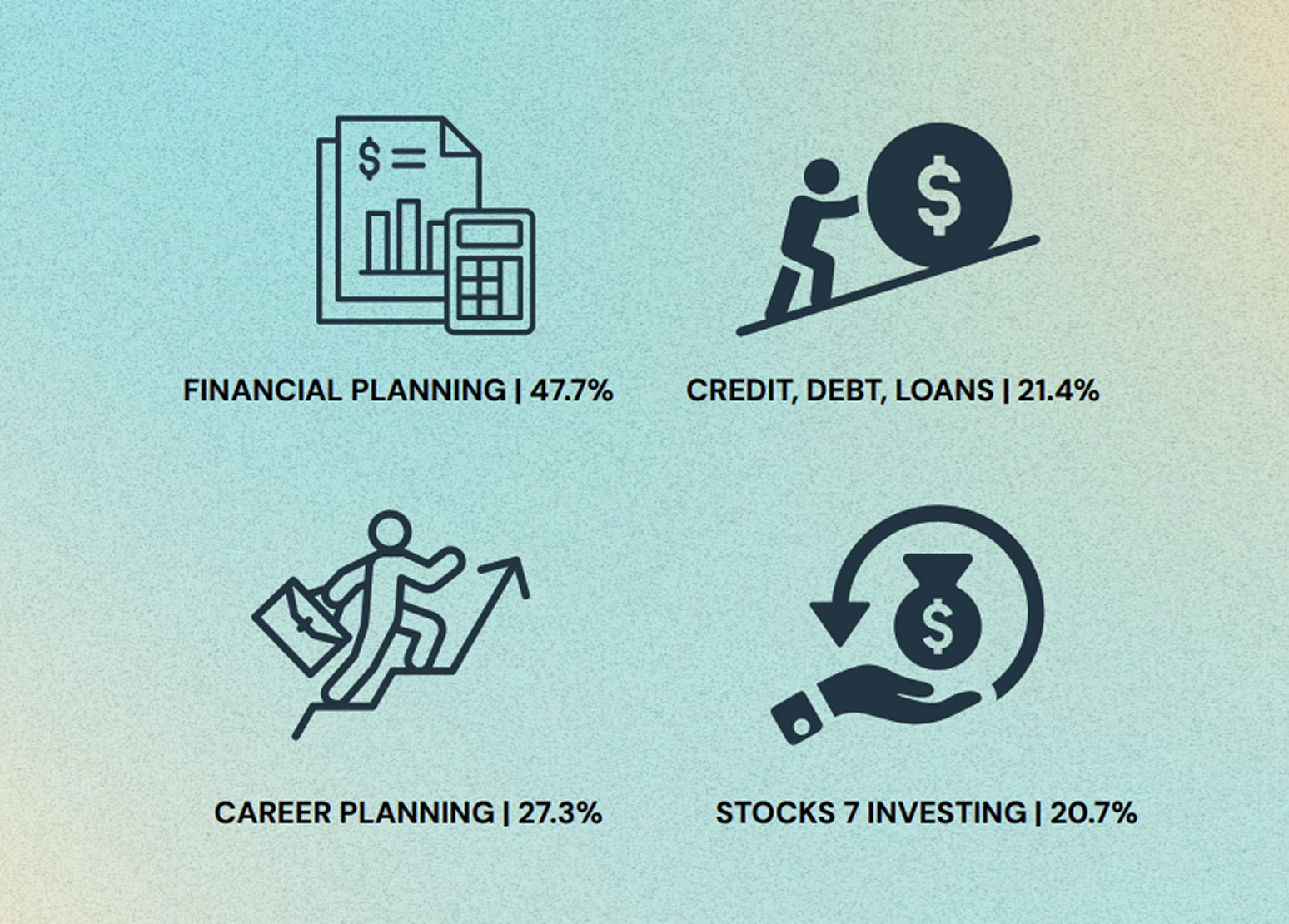
While 99.9% express active interest in finance, they consume financial planning tips (47.7%), credit and loan explainers (21.4%), career growth strategies (27.3%), and entry-level investing content (20.7%) alongside a wide array of lifestyle topics.
Top Interests of Under-35 investors
Their interests span Hobbies & Music (72–82%), Style & Fashion (53%), Food & Drink (50%), and Healthcare & Wellness (56%).
This integration means that a video explaining a Roth IRA can appear seamlessly in the same TikTok scroll as content about skincare, fashion, or pets. This audience consumes financial content in the same bite-sized, friendly, and values-driven formats they use for fashion, music, and skincare, indicating a preference for integrated lifestyle and finance content.
This generation is not a "Wall Street crowd"; they are lifestyle-driven, self-starting individuals who seek clarity, not complexity, and respond to authenticity and aspiration.
Cross-interests of Gen Z and Young Millennials

1 Audience insights are based on social affinity data modeled from large-scale digital behavior patterns. Values are directional, not absolute, and best used to understand relative interest and clustering trends.
Cross-interests of Gen Z and Young Millennials
To effectively engage under-35s, financial brands must acknowledge and reflect their everyday realities, such as balancing dating with budgeting, saving while maintaining personal style, and enjoying the present while building for the future. This requires making finance feel emotionally relevant by blending it with lifestyle themes. Creators outside the traditional finance sphere play a crucial role in this integration. For example, beauty influencers like Mikayla Nogueira and Bretman Rock, wellness creators like Dr. Muneeb Shah, and food critics such as Keith Lee (who partnered with Chime to demonstrate financial utility in everyday tipping scenarios) can bridge financial topics with self-expression, confidence, and well-being.
These creators help frame finance as something pursued for one's future self rather than an imposed obligation. The strong presence of music and pop culture personas further underscores the importance of cultural fluency as a financial lever. This presents opportunities to connect money to mood and meaning, such as through pop-ups at music festivals that demonstrate how to invest the cost of a ticket, turning cultural experiences into teachable, actionable touchpoints.
Implications for Creative and Media Terms
The pervasive integration of finance into under-35s's lifestyle means that creative and media teams must abandon traditional siloing of financial content. A simple "just do TikTok" approach is insufficient; content must feel native to the lifestyle scroll, seamlessly blending financial utility with cultural relevance. This necessitates thinking like a lifestyle brand that offers financial solutions, rather than a financial brand attempting to "do lifestyle."
Successful branded content for under-35s often blends identity, action, and access. Categories like "Ambition-led Banking," "Financial Literacy," and "Passion-led Paycheck" resonate strongly, tapping into under-35s's desire to transform their financial identity through small wins and meaningful goals. Content that offers actionable tips directly through brand platforms can be effective, but it must extend beyond mere product promotion to reflect under-35s's ambitions and passions. The most impactful approach combines educational value with cultural relevance, often achieved through collaborations with influencers and alignment with broader lifestyle platforms.
What This Audience Responds To:
- Confidence + Clarity: Break down financial topics without jargon.
- Actionable Tools: Budgeting templates, bill-split calculators, round-up savings apps.
- Relatable Storytelling: “Here’s how I paid off $10K in credit card debt before 30.”
- Smart Humor + Transparency: Think “dupe for a financial advisor” or “Walmart version of Wall Street.”
What to Avoid:
- Overly corporate tone or fear-based tactics (“don’t be broke!”).
- Complicated UIs or finance platforms that require heavy onboarding.
- Tone-deaf messaging that ignores economic stress or debt realities.
Strategic Implications
How financial services brands can win trust, attention, and long-term loyalty from the next investor class.

Most brands still market to under-35s like they’re broke kids
Under-35s is often mischaracterized as financially irresponsible or disengaged. But what they actually are is early-stage. They’re new to the game, not bad at it. Yet many financial brands still talk at them with complex terms, legacy visuals, or condescending tone. If your brand can make them feel capable, seen, and in control, you’ve already outperformed the pack.
8 Rules for Reaching Next-Gen Investors
1. Speak in stories, not spreadsheets. Education is important but story builds trust.
2. Don’t dumb it down, translate it. Under-35s are smart. They just don’t speak “bank.”
3. Design for emotion, not just navigation. UI that feels warm and affirming wins over cold utility
4. Create for the feed, not the funnel. Your content competes with cats and skincare hauls. Act accordingly.
5. Celebrate micro-moves. Big leaps scare them. Small wins hook them.
6. Be the guide, not the hero. Your job isn’t to shine, it’s to help them shine.
7. Track depth, not just reach. Time-on-site and bounce rate matter more than impressions
8. Evolve with them. This generation’s financial journey is just beginning. If your product grows with them, so will their loyalty
The Opportunity Ahead
The next generation of investors isn’t waiting in a bank lobby. They’re on the subway, scrolling TikTok. They’re on their lunch break, checking how much rent is going up. They’re searching, not for a platform, but for a partner.
The financial services brands that win them will:
RightMetric is your strategic insights partner
Book a chat with our team

APPENDIX
Our Data Sources.
We’ve partnered with 25+ of the world’s best marketing data sources, some of which are shown to the right.
Why this matters:
To accurately identify and understand trends, we need holistic data sources that cover all relevant channels on the internet.
Observation isn’t enough to come to robust conclusions. Empirical data must be part of the process.
For a deeper dive into our source data—which underpins the findings of this report— check out RightMetric’s “Our Data” page.

Complimentary Strategy Session
Take the next step in your market planning. Request your free strategy session today.
Book Your Session →
Is the #1 on-demand audience & competitor research service for marketing strategists.
Learn about RESEARCH-ON-DEMAND →